
The Ultimate Guide to Growing Your Business

Growing a business is painfully difficult, with many obstacles to overcome. I created the guide below to help you face these challenges.
Demonstrate Value
Your product or service must solve a problem that your customer faces. People want to be richer, sexier, or happier - can your product do that?
If so, make sure your potential customers immediately know that’s what your product will do for them.
For example, you aren’t selling an immunity supplement; you are offering them the youthfulness and energy needed to pursue their goals.
Be Niche
Sell to a specific niche in society rather than everybody. Instead of selling an ebook for personal trainers, sell an ebook for personal trainers who are restarting work after having their first baby.
Many won’t fit that description, but those who do will be more likely to buy as they feel the product was made for them. Getting engagement from 30% of a targeted group will likely yield higher returns than a tiny sliver (or nothing) of the general public.
Scarcity
Things that are hard to come by are naturally more valuable. Create higher demand by limiting your client list or product availability.
Indie brands such as Supreme drop limited stock that always sells out at a high price. They create hype by selling products that only a few will get their hands on.
Businesses that sell a service can create demand by selecting their client base. Being exclusive creates a sense of urgency and demand for their services. Clients may end up selling to them rather than the other way around.
Social Media and Ads
Put out lots of organic content in the form of reels across multiple social media platforms. Consider running ads on the content that overperforms relative to your other content.
Make sure to have a clear call to action (e.g., “Visit store.com to buy now”) at the end of those reels.
You can even target a specific customer base when running Meta ads. For example, if you sell ballet shoes for children, you can target mums of 5-year-olds who do ballet.
Call to Action (CTA)
Customers must instantly know how to buy or contact you. Place a clear CTA on your website and social media, such as a big “Buy Now” button or a well-located contact form.
Losing customers because they didn’t know how to buy your product is a disaster.
Make sure to add site links to your social media pages and post descriptions.
User Experience
Customers must instantly know what you do when arriving at your site.
Conduct a “usability test” by asking a friend or family member to look at your site. Do they instantly know what you are selling? Do they find it easy to navigate? If not, you must change your site.
Ask your mum or dad to navigate your website. Young people are so used to seeing the world from their own eyes that they do not realise that other demographics see things differently.
Be Simple and Concise
Read the book Writing That Works by Joel Raphaelson and Kenneth Roman. The text on your site should be clear and readable. Don’t use long words or paragraphs. For example, say “about” instead of “regarding.”
Most text on your landing page won’t be read, so only include key points. The classic advice is to halve the amount of text currently on your landing page.
Growth Strategies
Search Engine Optimisation (SEO)
SEO is how well your site ranks on Google when a user searches for a term related to your product or service.
Go to the Keyword Planner on Google Ads and type in your product name. The results will show the search terms people are entering when finding that product.
From the screenshot below, if you have a coffee brand, consider adding terms such as “coffee beans” and “coffee near me” to your site. As you can see, many users are searching for those terms.
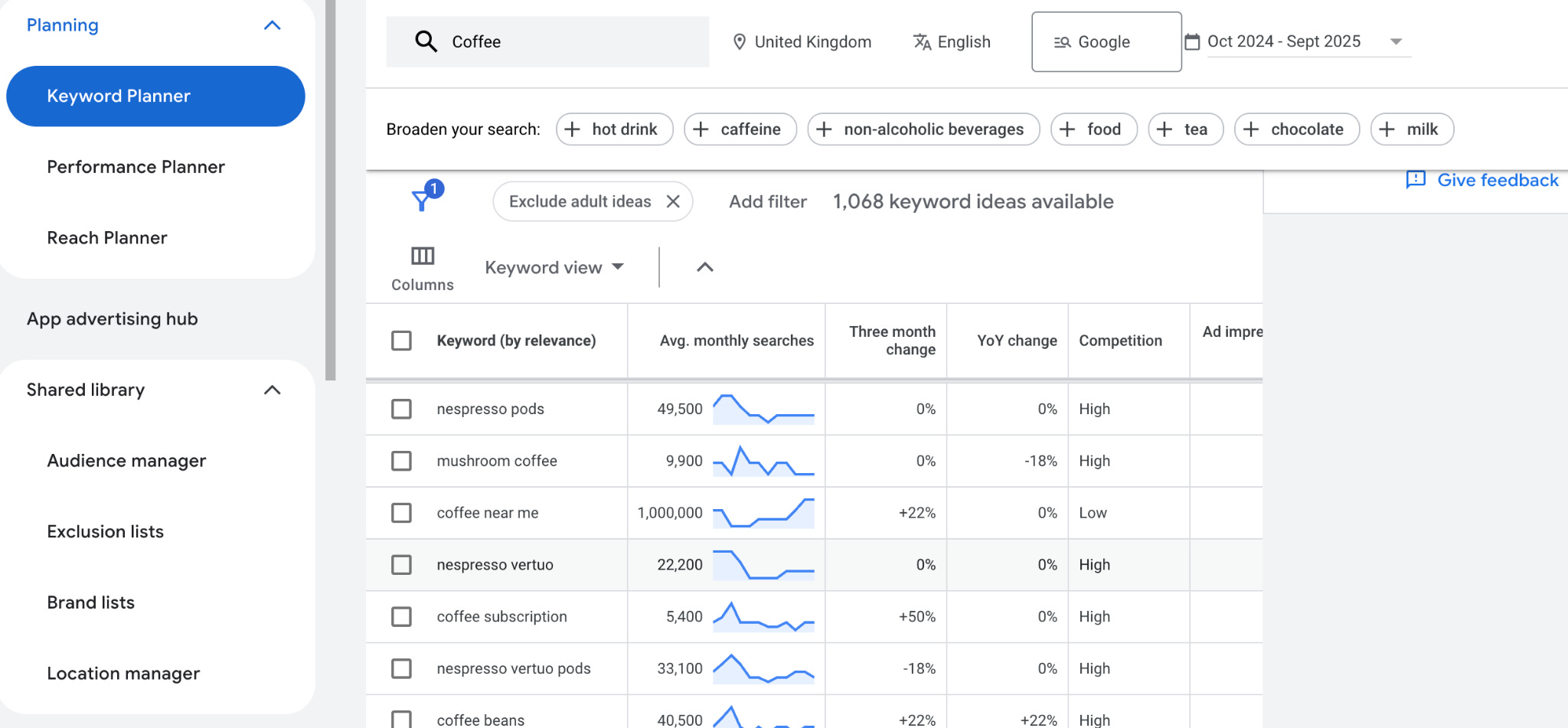
If you add those keywords, your site is more likely to rank higher on Google when people search for them.
Referral Schemes
Referral schemes are a good way to get viral growth through word of mouth. Although they can be effective for growth, be wary of high expenditures for paying out bonuses.
Direct Outreach
When Airbnb launched, they created bots that scraped Craigslist and emailed people who were already renting out rooms. Inviting these people to list on Airbnb was effective, as they were already open-minded about renting out a room.
The Airbnb founders even stayed in a few of these hosts’ apartments and offered to take higher-quality photos for their listings.
This is not a scalable strategy but can help acquire early adopters of your product or service.
Viral Social Media Growth
Many small businesses have become overnight successes by releasing a reel that receives a lot of engagement.
No one knows what is going to blow up on social media, so it is ill-advised to rely on this strategy. However, take a look at highly successful reels in your niche and see if you can mimic or take inspiration from them for your own potential viral reel.